Standalone samplers let you record, manipulate, sequence, and perform sounds without relying on a computer. The right model can become a compact beatmaking hub, a live performance instrument, or a fast sketchpad for complete tracks.
These 10 picks cover beginner-friendly samplers, portable production centers, grooveboxes, and advanced workstations. Use the guide below to narrow the options by workflow, connectivity, sequencing depth, and portability.
Best 10 Standalone Samplers Picks for 2026
Beginner Pick

- Built-in mic, analog input, and USB audio
- 64 GB storage with broad file import support
- Battery or USB powered with step sequencing
Best For: Beginners learning portable sampling and sequencing
Touchscreen Studio
1010music Blackbox Compact Sampler

- Touchscreen workflow for recording and sequencing
- Works with synths, drum machines, and other hardware
- Includes microSD, USB power, and MIDI adapters
Best For: Computer-free tabletop production with external gear
Groovebox Choice
Ableton Move Standalone Groovebox

- 32 aftertouch pads and hands-on sequencing controls
- Samples via mic, 3.5 mm input, or USB-C
- Rechargeable, speaker-equipped, and Live-integrated
Best For: Portable beatmaking and Ableton-centered performance
MPC Workflow Pick
Akai MPC Sample Portable Sampler

- 16 MPC pads with fast sample chopping
- Rechargeable, speaker-equipped, and computer-free
- Built-in effects plus USB-C audio/MIDI
Best For: Portable MPC-style beatmaking and finger drumming
Best Standalone Power

- Built-in processor, RAM, SSD, battery, and Wi-Fi
- 64 MPE-enabled expressive pads
- Audio interface, MIDI, CV/gate, and ADAT I/O
Best For: Laptop-free production and connected hardware setups
Best Compact Sampler
- Lightweight, battery-powered portable design
- Eight-voice polyphony and 16-step sequencing
- Pattern chaining, effects, speaker, and headphone output
Best For: Portable beat-making and compact sample sequencing
Best Groovebox Workflow
- 16 stereo tracks for layered arrangements
- Backlit performance pads for hands-on control
- 16GB microSD card and 5,000+ onboard samples
Best For: Pad-based standalone arrangements and live performance
Premium Retro Pick

- Computer-free production with MPC3 OS and an 8-core processor
- Expressive 3D-sensing MPCe pads
- 128GB storage, battery, microphone, and studio connectivity
Best For: Mobile producers seeking a full-featured standalone sampler with retro styling
Live DJ Performance Pick

- Standalone sampler and sequencer for laptop-free DJ sets
- 16 velocity-sensitive pads and a 7-inch touchscreen
- PRO DJ LINK syncs with CDJs and DJM mixers
Best For: DJs adding live samples, edits, and patterns to Pioneer DJ setups
Best All-Around Production Pick
- Full standalone production with MPC3 OS
- Expressive MPCe pads and clip-launching workflow
- Battery, speakers, microphone, and 128GB storage
Best For: Producers wanting a portable sampler for complete track creation
Beginner Pick – CASIO SXC-1 Portable Sampler
CASIO Portable STANDALONE Sampler SXC-1 Sampler for Beginners to Make and Play Songs Easily
Check Price On AmazonThe CASIO SXC-1 is a compact choice for beginners exploring standalone samplers. It combines a built-in microphone, external analog input, USB audio, onboard storage, and a step sequencer in a battery-powered design that is easy to carry.
Best For: Beginners who want a simple, portable sampler for recording sounds and building short sequences.
Pros:
- Supports recording through the built-in microphone, external analog input, or USB audio.
- Offers 64 GB of built-in eMMC storage and imports WAV, FLAC, and MP3 files through the companion app.
- Includes a 16-track step sequencer with up to eight segments and runs on USB power or four AAA batteries.
Cons:
- The 1.3-inch OLED display is relatively small.
- Its tone bank contains 16 tones, which may feel limited for advanced sound design.
The SXC-1 emphasizes accessibility over deep studio-style control. Its lightweight body, speaker, microphone, and straightforward sequencing features make it a practical entry point for portable sampling.
Touchscreen Studio – 1010music Blackbox Compact Sampler
The 1010music Blackbox is a compact standalone sampler for computer-free production. Its touchscreen workflow is designed for recording, editing, sequencing, and arranging samples while connecting external synths, drum machines, and other hardware.
Best For: Producers who want a small tabletop sampling studio with touchscreen control and external-device integration.
Pros:
- Supports recording, editing, sequencing, and song arrangement without a computer.
- Uses a fast touchscreen interface with keyboard and touch input options.
- Includes USB connectivity, two MIDI adapters, a microSD card, and a USB power setup.
Cons:
- The supplied notes do not specify built-in battery power, microphone, or speaker.
- Its compact touchscreen-focused design may not suit users seeking physical pad-based control.
Blackbox makes the most sense as a focused tabletop hub rather than an all-in-one portable instrument. It is particularly useful when your setup already includes external instruments and MIDI-capable gear.
Groovebox Choice – Ableton Move Standalone Groovebox
Ableton Move is a standalone groovebox and sampler built for sketching, arranging, and performing without a computer. Its rechargeable battery, speaker, microphone, pressure-sensitive pads, four flexible tracks, and onboard effects make it one of the more complete standalone samplers for mobile music making.
Best For: Ableton users and performers who want pad-based sampling, sequencing, and wireless integration in a portable instrument.
Pros:
- Offers 32 velocity-sensitive pads with polyphonic aftertouch, nine touch-sensitive encoders, and a 16-step sequencer.
- Samples through the built-in microphone, 3.5 mm input, or USB-C, with onboard slicing and internal resampling.
- Includes a rechargeable battery, speaker, 64 GB storage, 1,500-plus sounds, effects, and Ableton Live 12 Intro.
Cons:
- The four-track structure may be restrictive for larger arrangements made entirely on the device.
- Ableton Live 12 Intro has limited tracks, instruments, and effects compared with fuller editions.
Move stands out when hands-on performance and Ableton workflow matter as much as sampling. It offers broad creative features in standalone use while retaining useful connections to Live, Cloud, Link, and external audio workflows.
MPC Workflow Pick – Akai MPC Sample Portable Sampler
The Akai Professional MPC Sample brings a familiar MPC workflow to a compact standalone sampler. It combines battery-powered operation, a built-in microphone and speaker, 16 pads, sample chopping, sequencing, effects, and microSD storage for computer-free beatmaking.
Best For: Beatmakers, finger drummers, and DAWless creators who want portable MPC-style sampling and sequencing.
Pros:
- Provides 16 responsive MPC pads, a 2.4-inch color display, and an Instant Sample Chop workflow.
- Includes a rechargeable battery, built-in microphone, speaker, microSD storage, and internal resampling.
- Offers four effects processors, 60 effect types, USB-C audio/MIDI, and stereo line connectivity.
Cons:
- The included MIDI adapters are not supplied, so MIDI DIN connections require an additional adapter.
- Its 16-pad layout provides less pad space than larger MPC-style controllers.
MPC Sample is a strong fit for producers who value quick chopping, finger drumming, and recognizable MPC-style beat construction. Its I/O and USB-C connectivity also let it move from portable sessions into live or home-studio setups.
Best Standalone Power – Push 3 Standalone Workstation
The Ableton Push 3 is a powerful choice among standalone samplers for musicians who want to leave the laptop behind. Its built-in processor, 8GB of RAM, 256GB SSD, battery, Wi-Fi, audio interface, and Ableton Live Intro software make it a broad creative hub for sampling, sequencing, recording, and hardware control.
Best For: Producers who want an expressive, laptop-free workstation that can also connect to instruments, modular gear, microphones, and external effects.
Pros:
- Operates standalone with built-in storage, processing, battery, and Wi-Fi.
- Offers 64 MPE-enabled pads with XY sensing for expressive performance.
- Includes a built-in audio interface, ADAT optical I/O, MIDI, and CV/gate connectivity.
- Supports direct recording from guitars, microphones, turntables, and hardware synths.
Cons:
- Its extensive capabilities may be more than needed for simple sample playback.
- At 15 inches square, it is less compact than pocket-sized samplers.
Push 3 stands out for its combination of standalone operation, expressive pads, recording features, and deep connectivity. It is best viewed as the central workstation in a laptop-free setup rather than a minimal sample player.
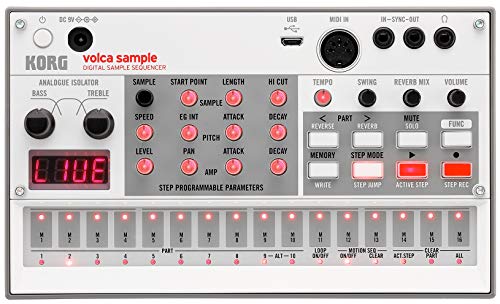
Best Compact Sampler – Korg Volca Sample 2
Korg Volca Sample 2 Digital Sample Sequencer Drum Machine w/Pattern Chain Mode and 16-step Sequencer
Check Price On AmazonThe Korg Volca Sample 2 is a lightweight option among standalone samplers, combining sample-based drum production with a compact 16-step sequencer. It includes pattern chaining, eight-voice polyphony, onboard effects, an integrated speaker, and battery operation for portable beat-making.
Best For: Beatmakers who want an affordable, portable sampler for patterns, drum parts, and styles such as trap, future bass, and lo-fi hip-hop.
Pros:
- Compact design weighs under a pound and runs on six AA batteries or an AC adapter.
- Provides eight-voice polyphony and a 16-step sequencer with pattern chaining.
- Has double the memory of previous models for additional samples and longer recordings.
- Includes digital reverb, a double filter, an integrated speaker, and headphone output.
Cons:
- Its 16-step sequencing approach is more limited than a full workstation.
- Sample management requires dedicated librarian software on Mac or PC.
The Volca Sample 2 prioritizes portability and immediate groove creation. Its battery power, speaker, effects, and pattern-chain mode make it a practical travel companion, while the Micro USB connection supports computer and DAW workflows.
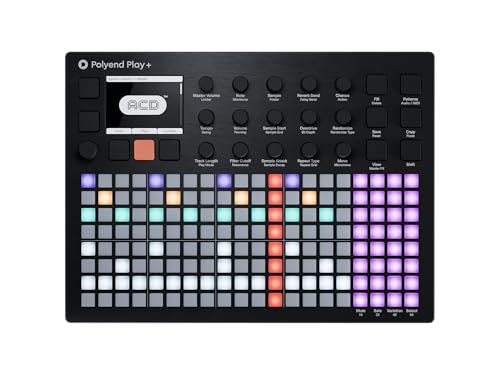
Best Groovebox Workflow – Polyend Play+ Workstation
The Polyend Play+ combines a standalone synthesizer, sampler, and MIDI workstation in a performance-focused groovebox. Its 16 stereo tracks, backlit pads, 16GB microSD card, and library of more than 5,000 onboard samples make it suited to building layered arrangements without relying on a computer.
Best For: Producers and performers who want a pad-based standalone workstation for arranging samples, synth parts, and MIDI tracks.
Pros:
- Provides 16 stereo tracks for developing larger groovebox arrangements.
- Includes backlit performance pads for hands-on control.
- Ships with a 16GB microSD card and more than 5,000 onboard samples.
- Offers USB connectivity and a dedicated 3.5mm headphone output.
Cons:
- Its supplied notes do not specify a built-in speaker for untethered monitoring.
- It may be less focused than a dedicated drum sampler for simple beat-making.
Play+ is a strong middle ground for users who want more arrangement capacity than a small sample sequencer while retaining a hands-on pad workflow. Its stereo-track count and sizable sample library are particularly useful for building complete groovebox performances.
Premium Retro Pick – Akai MPC Live III Retro
The Akai MPC Live III Retro is a powerful choice among standalone samplers for producers who want full song creation without a computer. Its rechargeable battery, built-in microphone and speakers, large internal storage, and extensive connectivity make it suitable for both mobile production and studio integration.
Best For: Producers who want a feature-rich, portable standalone sampler with a distinctive vintage-inspired finish.
Pros:
- Runs without a computer using the MPC3 OS and an 8-core processor.
- 3D-sensing MPCe pads provide velocity, pressure, and X/Y control.
- Includes 128GB of internal storage, expandable via SD or SSD.
- Built-in microphone, stereo monitors, rechargeable battery, and broad studio connectivity.
Cons:
- Its extensive features may be more than beginners need.
- The 3.9 kg weight is less convenient than smaller portable samplers.
The MPC Live III Retro is best viewed as a complete music production center rather than a basic sample trigger. Choose it if deep sequencing, clip launching, plugin support, and standalone flexibility matter more than keeping the setup minimal.
Live DJ Performance Pick – Pioneer DJ DJS-1000
The Pioneer DJ DJS-1000 is a focused option among standalone samplers for DJs who want hands-on live control without a laptop. Its 16 velocity-sensitive pads, 7-inch touchscreen, step sequencer, and PRO DJ LINK support are designed for adding patterns, edits, and original elements directly to a DJ set.
Best For: DJs who want to trigger samples and build live patterns alongside compatible Pioneer DJ equipment.
Pros:
- Standalone operation eliminates the need for a laptop during performance.
- Sixteen velocity-sensitive pads support tactile sample triggering.
- Seven-inch touchscreen and step sequencer simplify pattern creation.
- PRO DJ LINK synchronizes samples with CDJs and DJM mixers.
Cons:
- Its workflow is more performance-focused than a complete production workstation.
- At 15 pounds, it is less portable than compact battery-powered units.
The DJS-1000 makes the most sense for DJs who prioritize live remixing and beat triggering over extensive composition tools. It is a practical booth companion when synchronization with Pioneer DJ gear is central to the setup.
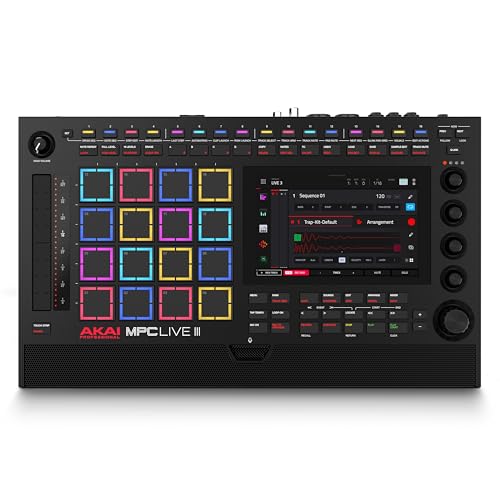
Best All-Around Production Pick – Akai MPC Live III
The Akai MPC Live III is a versatile choice among standalone samplers for creating, recording, mixing, and performing without a computer. It combines an 8-core processor, 8GB of RAM, 128GB storage, expressive MPCe pads, and a rechargeable battery in a portable production-focused design.
Best For: Producers who want one standalone sampler for beatmaking, sampling, sequencing, clip launching, and complete track development.
Pros:
- Standalone MPC3 workflow supports production without a computer.
- 3D-sensing pads enable velocity, pressure, and X/Y performance control.
- Rechargeable battery, stereo speakers, microphone, and 128GB internal storage support mobile work.
- Offers USB-C, MIDI, CV/Gate, audio inputs, multiple outputs, and audio interface functionality.
Cons:
- The broad feature set may require time to learn.
- It is designed as a full production center rather than a simple sampler.
The MPC Live III is a strong fit when flexibility is the priority. Its combination of standalone operation, portable hardware, expansive sequencing tools, and studio connections lets it handle both quick beat sketches and more developed productions.
How We Picked These Standalone Samplers
We selected these Standalone Samplers to represent the main ways musicians work with sampled audio. The lineup includes compact units for quick beatmaking, performance-focused instruments with pads and touchscreens, and fuller production workstations with deeper sequencing and arrangement tools.
Our comparison emphasizes independent operation, sampling workflow, sequencing, portability, storage, connectivity, and suitability for different experience levels. Models that integrate with desktop software can be useful, but each product is considered primarily as a computer-free music-making tool.
Quick Comparison
| Best For | Look For | Typical Strength |
|---|---|---|
| Beginners | Simple controls and guided workflows | Fast learning curve |
| Beatmakers | Pads, chopping, sequencing, and effects | Hands-on rhythm production |
| Live performers | Reliable triggering, scenes, and pattern control | Immediate performance access |
| Full productions | Audio recording, arrangement, storage, and connectivity | Computer-free song completion |
| Portable setups | Battery operation, compact size, and lightweight design | Production anywhere |
Key Buying Factors for Standalone Samplers
Sampling and Sound-Shaping Workflow
Check how easily you can record from a microphone, line input, or external device, then trim, slice, tune, stretch, and layer the result. A fast workflow matters more than a long feature list when you want to capture ideas quickly.
Sequencing and Arrangement
Some units focus on patterns and clip-style performance, while others support longer arrangements and complete songs. Choose pattern-oriented hardware for improvisation and groove creation; select a workstation-style model if you expect to arrange vocals, instruments, and multiple song sections.
Controls and Display
Large pads, knobs, touchscreen navigation, and dedicated buttons each suit different users. Pad-heavy designs are effective for finger drumming and sample launching, while screens and encoders can make detailed editing easier.
Connectivity and Expansion
Review inputs, outputs, MIDI, USB, audio interfaces, storage options, and wireless features. If you plan to connect microphones, instruments, turntables, or external synthesizers, make sure the sampler has the required connections and enough routing flexibility.
Portability and Power
Size, weight, battery support, and storage capacity affect whether a sampler works for travel, rehearsals, or live shows. Compact models are easier to carry, but larger workstations often provide better control and more room for complex projects.
Who Should Buy Which Standalone Samplers?
New producers should prioritize clear controls, approachable sequencing, and a low-friction sampling process. Beatmakers will generally benefit from responsive pads, quick sample chopping, and strong drum sequencing. Live performers should focus on dependable triggering, pattern changes, hands-on effects, and straightforward preparation.
Electronic musicians and hybrid setups should examine MIDI, audio routing, synchronization, and external gear support. Songwriters and producers seeking a computer-free studio should choose a model with deeper arrangement features, generous storage, audio recording, and enough connectivity for the rest of their setup. Finally, traveling creators should favor a compact, battery-friendly sampler that can turn short sessions into usable musical ideas.