The best passive subwoofers can add deep, controlled bass without forcing you into a built-in amplifier or a fixed system design. That flexibility makes them useful for home theater, DJ rigs, live sound, and custom speaker projects.
Our roundup includes large 15- and 18-inch PA models, compact home-audio options, and dedicated amplifiers for driving passive bass speakers. Use the buying guide below to match enclosure size, impedance, power handling, and intended use.
Best 10 Passive Subwoofers Picks for 2026
High-Output Pick
Rockville PBG18 18-Inch Passive Subwoofer

- 1,000W RMS and 2,000W peak handling
- Rugged MDF cabinet with pole mount
- SpeakON and 1/4-inch parallel connections
Best For: DJs, live sound, and large professional audio systems
Stage-Ready Choice
JBL JRX218S 18-Inch Passive Subwoofer

- 350W continuous and 1,400W peak capacity
- Durable carpet-covered 19mm MDF cabinet
- Top-mounted 35mm pole receptacle
Best For: Portable PA and stage sound systems
Amplifier Pairing Pick
Fosi Audio BT30D Pro 2.1 Amplifier

- Dedicated passive subwoofer output
- 165W x2 plus 350W rated output
- Adjustable subwoofer frequency and volume
Best For: Compact 2.1 systems using passive subwoofers
Portable DJ Pick
Rockville SBG1158 15-Inch Passive Subwoofer

- 400W RMS and 800W peak handling
- Rear-ported MDF cabinet with pole mount
- SpeakON, 1/4-inch, and binding-post connections
Best For: Mobile DJs and portable event sound systems
Compact Pick
Dayton Audio MKSX4 Low-Profile Passive Subwoofer

- Four-driver low-profile design
- Dual slot ports help reduce turbulence
- Feet allow upright or flat placement
Best For: Small rooms, desktop audio, and compact home theater setups
Pro DJ Powerhouse
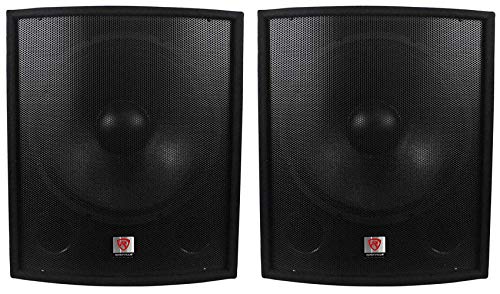
Rockville SBG1188 18-Inch Passive Subwoofers
- Two 18-inch cabinets included
- 500 watts RMS per subwoofer
- Multiple wired input and output connections
Best For: DJ rigs, PA systems, and high-volume performance spaces
Home Theater Value

- 8-inch driver for indoor home theater use
- Ground booster aims to enhance bass
- Requires an external compatible amplifier
Best For: Home theaters with an existing amplifier or stereo receiver
Best Amplifier for Passive Subwoofers
Fosi Audio M04 Subwoofer Amplifier

- 100-watt mono output for compatible passive loads
- Selectable subwoofer or full-frequency mode
- Compact Class D design with low-pass filter
Best For: Adding dedicated amplification and bass control to a passive subwoofer
Best Compact Passive Subwoofer

- 100W RMS and 150W peak power handling
- Compact enclosure with shock-absorbing base
- Requires a compatible 4-ohm external amplifier
Best For: Small home theater or stereo systems needing added wired bass
Best MDF Passive Subwoofer
Audio Fantasy SUB65 6.5-Inch Subwoofer

- 100W RMS and 150W peak bass handling
- MDF cabinet with down-firing woofer
- Anti-shock base and two-year warranty
Best For: Compact home theater, studio, gaming, and party systems
High-Output Pick – Rockville PBG18 18-Inch Passive Subwoofer
The Rockville PBG18 is one of the most powerful passive subwoofers in this roundup, pairing an 18-inch woofer with 1,000W RMS and 2,000W peak handling. Its rugged MDF cabinet, pole mount, and parallel SpeakON and 1/4-inch connections make it a practical choice for larger professional audio systems.
Best For: DJs, live sound setups, and users who need substantial low-frequency output.
Pros:
- 18-inch woofer with 35Hz-4kHz frequency response.
- High 1,000W RMS and 2,000W peak power ratings.
- Durable carpet-covered MDF cabinet with steel grille and recessed handles.
- Includes pole mount, rubber feet, SpeakON connections, and 1/4-inch jacks.
Cons:
- Large 64-pound cabinet requires considerable storage and transport space.
- As a passive subwoofer, it requires a compatible amplifier.
The PBG18 stands out when maximum output and rugged portability matter more than a compact footprint. Confirm that your amplifier supports its 8-ohm impedance and power requirements before pairing it with the speaker.
Stage-Ready Choice – JBL JRX218S 18-Inch Passive Subwoofer
The JBL JRX218S is a portable 18-inch passive subwoofer designed for music and stage applications. With 350W continuous and 1,400W peak power handling, a 34Hz frequency specification, and a durable MDF enclosure, it suits systems that need dependable low-end reinforcement.
Best For: Portable PA systems, stage setups, and JBL-compatible speaker configurations.
Pros:
- 18-inch driver with 350W continuous and 1,400W peak capacity.
- Rugged 19mm MDF enclosure covered in black carpet.
- Top-mounted 35mm cast-aluminum pole receptacle.
- Non-resonant steel handles support transport.
Cons:
- Its 4-ohm impedance requires careful amplifier matching.
- Only Speakon connectivity is listed.
- At 32.5kg, it is not a lightweight option for frequent transport.
The JRX218S is a sensible pick for users building a traditional wired PA system around JBL Professional components. Its pole-mount design adds flexibility, while the 4-ohm load should be checked against the amplifier before purchase.
Amplifier Pairing Pick – Fosi Audio BT30D Pro 2.1 Amplifier
The Fosi Audio BT30D Pro is not a passive subwoofer itself; it is a compact 2.1 amplifier for driving passive subwoofers and stereo speakers. It provides a dedicated subwoofer output, adjustable subwoofer frequency from 0 to 300Hz, bass volume control, and Bluetooth 5.0 connectivity for flexible home or desktop setups.
Best For: Users who need a compact amplifier to integrate passive subwoofers into a 2.1 system.
Pros:
- Dedicated passive subwoofer output plus two passive speaker outputs.
- Rated output of 165W x2 plus 350W for the subwoofer channel.
- Separate subwoofer frequency and volume controls.
- Bluetooth 5.0 with a stated range of up to 15 meters.
Cons:
- This is an amplifier, not a standalone passive subwoofer.
- Its compact output rating may not suit large venue systems.
- Bluetooth range and performance depend on the listening environment.
For desktop, bookshelf, or smaller home audio systems, the BT30D Pro offers the controls needed to tune a passive subwoofer without adding a full-size receiver. Match the amplifier’s output and connections to the specific subwoofer you plan to use.
Portable DJ Pick – Rockville SBG1158 15-Inch Passive Subwoofer
The Rockville SBG1158 is a 15-inch passive subwoofer built for mobile sound systems, DJ work, and events. Its 400W RMS and 800W peak ratings, rear-ported MDF enclosure, pole mount, and multiple wired connection options provide a useful balance of output and portability.
Best For: Mobile DJs, small-to-medium event systems, and users prioritizing easier transport.
Pros:
- 15-inch woofer with 400W RMS and 800W peak handling.
- Rear-ported cabinet supports bass response and efficiency.
- Offers SpeakON, 1/4-inch, and binding post/banana plug connections.
- Recessed handles, carpet covering, steel grille, and pole mount aid mobile use.
Cons:
- It produces less rated output than the larger 18-inch options.
- As an 8-ohm passive subwoofer, it needs a suitable external amplifier.
- The supplied frequency-response detail is limited to a 500Hz specification.
The SBG1158 is a practical middle ground for passive subwoofer buyers who want useful low-end reinforcement without moving an 18-inch cabinet. Its 8-ohm load and 400W RMS rating should guide amplifier selection.
Compact Pick – Dayton Audio MKSX4 Low-Profile Passive Subwoofer
The Dayton Audio MKSX4 is a space-conscious option for shoppers comparing passive subwoofers for desktop systems, televisions, projectors, or other compact home audio setups. Its four-driver layout, dual slot ports, and removable feet give it flexible placement options.
Best For: Small rooms, desktop audio, and users who want a low-profile subwoofer that can stand upright or lie flat.
Pros:
- Four-driver design delivers a compact combination of form and function.
- Dual slot ports are designed to minimize air turbulence.
- Removable rubber feet support upright or horizontal installation.
- Uses the same high-excursion drivers as Dayton Audio MK402 bookshelf speakers for a matched setup.
Cons:
- Its 4-inch drivers are better suited to compact systems than high-output installations.
- As a passive subwoofer, system compatibility and amplification should be confirmed before purchase.
Choose the MKSX4 when placement flexibility and a small footprint matter more than the output of a large-format cabinet. Its design makes it a practical companion for modest home audio systems.
Pro DJ Powerhouse – Rockville SBG1188 18-Inch Passive Subwoofers
The Rockville SBG1188 two-pack is built for shoppers seeking passive subwoofers for DJ and PA applications. Each 18-inch cabinet handles 500 watts RMS, while the dual ported enclosures, 96 dB sensitivity, and multiple wired connection options support high-volume performance setups.
Best For: DJs, live performances, PA systems, and permanent installations that need substantial low-frequency output.
Pros:
- Two 18-inch subwoofers provide 2,000 watts of combined peak power.
- Each cabinet offers 500 watts RMS handling with an 8-ohm nominal impedance.
- Dual ported enclosures and a 20 Hz–500 Hz stated frequency response support deep bass.
- SpeakON, 1/4-inch, and binding post/banana plug connections add setup flexibility.
Cons:
- The two cabinets are large and heavy at 53 pounds each.
- They require external amplification and wired connections.
- They are not waterproof, so outdoor use requires suitable protection.
This Rockville package is a strong fit when output and professional connectivity take priority over portability. Its size and weight make it better suited to dedicated performance spaces than casual home listening.
Home Theater Value – 8-Inch 100W Passive Subwoofer
This 8-inch model is a straightforward choice for shoppers comparing passive subwoofers for home theater systems. Its synthetic-fiber-wood cabinet, ground booster design, and stated 40 Hz frequency response are aimed at adding deeper bass, but an external compatible amplifier is required.
Best For: Home theater users who already have a compatible amplifier or stereo receiver and want an affordable wired bass speaker.
Pros:
- 8-inch driver is sized for home theater and general indoor listening.
- Ground booster and low-pass filtering are designed to enhance ambient bass and reduce directionality.
- Synthetic-fiber-wood construction is intended to provide durability and stability.
- 40 mm machine base is designed for shock absorption and ground stability.
Cons:
- No built-in amplifier; an external compatible amplifier is required.
- Compatibility with a TV or other source should be verified before purchase.
- The product information gives conflicting power figures, listing 100 watts in the title and 150 watts in the specifications.
Consider this model if you want a basic 8-inch passive subwoofer and already own the necessary amplification. Its feature set is focused on practical home theater bass rather than wireless convenience or professional PA use.
Best Amplifier for Passive Subwoofers – Fosi Audio M04 Subwoofer Amplifier
Unlike a passive subwoofer itself, the Fosi Audio M04 is a compact mono amplifier designed to power passive subwoofers or speakers. Its selectable subwoofer mode, built-in low-pass filter, and sub-frequency control make it a practical way to add dedicated bass amplification to a home audio system.
Best For: Home theater listeners who need a small, affordable amplifier for a passive subwoofer.
Pros:
- Provides up to 100 watts for a 2-ohm subwoofer or speaker.
- Selectable subwoofer and full-frequency mono amplifier modes.
- Built-in low-pass filter and sub-frequency control support bass tuning.
- Compact Class D design measures 5.2 x 3.5 x 1.4 inches.
Cons:
- This is an amplifier, not a passive subwoofer enclosure.
- Its single-channel design is intended for mono bass amplification.
- The included power supply is rated at 19V/4.74A, so placement depends on access to an outlet.
The M04 is a useful companion for passive subwoofers when you want straightforward bass control without adding a full-size amplifier. Check your subwoofer’s impedance and connection requirements before buying.
Best Compact Passive Subwoofer – 6.5-Inch Wired Bass Speaker
This 6.5-inch passive subwoofer is a compact, wired bass speaker for home theater, music, games, and party audio. Because it is unpowered, it requires a compatible external amplifier and should be connected with speaker wire rather than directly to a TV, phone, or tablet.
Best For: Smaller home audio setups that need a space-saving bass upgrade and already have a suitable amplifier.
Pros:
- Handles 100W RMS and 150W peak power.
- Compact wood-style enclosure fits beside a media console or TV stand.
- 4-ohm wired connection provides a straightforward installation.
- Elevated 40 mm shock-absorbing base supports stability and bass reflection.
Cons:
- Requires an external amplifier and cannot operate by itself.
- Amplifier compatibility with a 4-ohm load should be confirmed before installation.
- There is no wireless connectivity.
For buyers comparing passive subwoofers for a compact room, this model offers a simple wired setup and modest cabinet footprint. Pair it with an amplifier that can safely drive its 4-ohm impedance and power range.
Best MDF Passive Subwoofer – Audio Fantasy SUB65 6.5-Inch Subwoofer
The Audio Fantasy SUB65 is a 6.5-inch passive subwoofer built for home theater, studio, gaming, and party use. Its MDF cabinet, down-firing driver, and anti-shock base are designed for a compact setup, but an external amplifier or receiver is required for operation.
Best For: Small- to medium-room systems that want a compact passive subwoofer with a wood cabinet and down-firing design.
Pros:
- Offers 100W RMS and 150W peak power handling.
- High-density MDF cabinet is intended to reduce acoustic resonance.
- Down-firing 6.5-inch woofer and 40 mm anti-shock base support stable bass output.
- Includes a two-year manufacturer warranty.
Cons:
- It cannot be used alone and requires an external amplifier or receiver.
- The 4-ohm impedance requires a compatible amplifier.
- The supplied connection arrangement may require additional cables for interfaces other than the stated RCA setup.
The SUB65 is a sensible option among passive subwoofers when cabinet construction and a down-firing layout matter. Its compact dimensions make it easier to position, while the required amplifier gives you flexibility to match power to your system.
How We Picked These Passive Subwoofers
We selected models across the main passive-subwoofer use cases: live sound, mobile DJ work, home theater, desktop listening, and DIY or compact installations. We considered driver size, stated power handling, impedance, enclosure construction, portability, mounting options, and compatibility with external amplifiers.
Because a passive subwoofer depends on a separate amplifier, we also included subwoofer amplifier options that can help complete a system. Specifications such as wattage and frequency response are manufacturer claims, so real-world output will vary with room acoustics, crossover settings, amplifier quality, and placement.
Quick Comparison
| Best For | What to Look For | Typical Choice |
|---|---|---|
| Large PA systems | 15- or 18-inch driver, high power handling, rugged cabinet | Rockville or JBL stage subwoofer |
| Mobile DJ setups | Portable MDF enclosure, 8-ohm load, pole-mount support | 15-inch passive DJ subwoofer |
| Home theater | Compact cabinet, suitable impedance, clean amplifier integration | 6.5- or 8-inch passive model |
| Low-profile installations | Shallow enclosure and modest amplifier requirements | Dayton Audio compact subwoofer |
| Custom systems | Flexible amplifier controls and adequate power reserve | Fosi Audio subwoofer amplifier |
Key Buying Factors for Passive Subwoofers
Driver Size and Output
Larger drivers generally move more air and are better suited to high-volume music and larger rooms. An 18-inch model can deliver substantial low-end impact, while a 6.5- or 8-inch enclosure is easier to place and may integrate more naturally in a small room.
Impedance and Amplifier Matching
Check whether the subwoofer is rated at 4 or 8 ohms, then confirm that your amplifier supports that load. Match the amplifier’s continuous power to the speaker’s realistic power-handling range, leaving some headroom while avoiding excessive gain or clipping.
Crossover and System Integration
A passive subwoofer needs more than a speaker connection. Ideally, your amplifier or processor should provide a low-pass crossover, phase or polarity control, and a suitable line-level or speaker-level connection. Without filtering, bass can sound muddy or overlap heavily with the main speakers.
Cabinet, Portability, and Placement
MDF cabinets can offer good value and rigidity, but large PA enclosures are heavy. Look for handles, pole mounts, protective corners, and durable connectors if you travel with the system. In a home, place the subwoofer near a wall or corner for more output, then adjust placement to reduce boomy bass.
Who Should Buy Which Passive Subwoofers?
Choose an 18-inch passive subwoofer if you need strong output for live events, DJs, or large spaces. A 15-inch option is a more portable compromise for parties and medium-sized venues. For home theater or music in smaller rooms, compact 6.5-, 8-inch, or low-profile designs are easier to blend with existing speakers.
Buy a dedicated subwoofer amplifier when your receiver or power amplifier cannot safely drive the passive enclosure or lacks the necessary crossover controls. If you want the simplest setup, verify every connector, impedance rating, and amplifier specification before ordering. Passive systems reward careful matching, but the wrong pairing can limit output or damage equipment.