The best handheld GPS devices for geocaching make it easier to navigate to coordinates, follow trails, and stay oriented when phone service is unreliable. The right model depends on your accuracy needs, mapping preferences, durability requirements, and budget.
We compared 10 popular options, including compact Garmin eTrex units, advanced GPSMAP models, touchscreen navigators, and a satellite communicator, to help you choose a dependable device for your next cache hunt.
Best 10 Handheld Gps Devices for Geocaching Picks for 2026
Reliable Trail Starter

- 2.2-inch sunlight-readable color display
- Preloaded routable TopoActive maps
- Up to 25 hours on two AA batteries
Best For: Casual geocaching and hiking with dependable basic navigation
Precision in Tough Terrain
- Multi-band and expanded GNSS support
- 3-axis compass and barometric altimeter
- Routable maps and U.S. public land boundaries
Best For: Geocaching in forests, steep country, and urban canyons
Connected Long-Life Pick

- Automatic Geocaching Live cache updates
- Up to 168 hours of standard-mode battery life
- Multi-GNSS support and IPX7 water resistance
Best For: Extended geocaching trips with smartphone connectivity
Accurate Mapping Value

- Multi-band and expanded GNSS support
- Large 2.6-inch sunlight-readable display
- Routable maps and public land boundaries included
Best For: Geocachers seeking advanced reception without extra ABC sensors
Best All-Around Pick

- Color display with routable TopoActive maps
- GPS and GLONASS satellite support
- Up to 25 hours on two AA batteries
Best For: Geocachers seeking balanced mapping and durability
Best for Remote Adventures
- InReach messaging and interactive SOS
- 3-inch color display with TOPO maps
- Up to 200 hours in Expedition mode
Best For: Remote geocaching where satellite communication matters
Best Budget Navigator

- Paperless geocaching support
- IPX7-rated rugged, waterproof design
- Up to 20 hours on two AA batteries
Best For: Simple and affordable geocaching navigation
Best Touchscreen Pick

- 3-inch sunlight-readable touchscreen
- Geocache profile and Connect IQ support
- IPX7-rated design with 16-hour battery
Best For: Geocachers who prefer touchscreen navigation and customization
Best Battery Life

- Up to 36 hours per charge
- Multi-GNSS support with USA Topo maps
- 3.2-inch screen and physical buttons
Best For: Long hikes and geocaching trips needing extended runtime
Best for Preloaded Geocaches

- 250,000 worldwide geocaches preloaded
- GPS/GLONASS and track management
- 8-megapixel geotagging camera
Best For: Geocachers wanting ready-to-use cache data and trip documentation
Reliable Trail Starter – Garmin eTrex 22x
The Garmin eTrex 22x is a practical entry point among handheld GPS devices for geocaching, with a compact color screen, preloaded routable maps, and button controls that are easy to use outdoors. GPS and GLONASS support can help maintain tracking in more challenging environments.
Best For: Geocachers and hikers who want dependable basic navigation with long battery life and expandable map storage.
Pros:
- Sunlight-readable 2.2-inch color display with 240 x 320 resolution
- Preloaded TopoActive maps include routable roads and trails
- Up to 25 hours of battery life with two AA batteries
- 8 GB of internal storage plus a microSD card slot
Cons:
- No touchscreen, so navigation relies on buttons
- Smaller display than the GPSMAP 65-series models
- Geocaching features are less extensive in the supplied specifications than the eTrex SE
The eTrex 22x favors straightforward operation and proven battery performance over newer connected features. It is a sensible choice for casual to regular geocaching trips where reliable mapping matters more than advanced satellite technology.
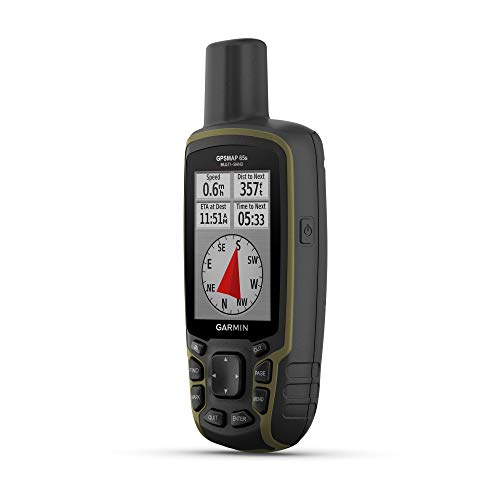
Precision in Tough Terrain – Garmin GPSMAP 65s
The Garmin GPSMAP 65s is built for handheld GPS devices for geocaching users who often navigate forests, steep terrain, or urban areas where signal conditions can be difficult. Its multi-band technology, expanded GNSS support, compass, and barometric altimeter add useful confidence in the field.
Best For: Experienced geocachers who prioritize positioning accuracy and extra navigation sensors in challenging environments.
Pros:
- Multi-band technology and expanded GNSS support for difficult locations
- 2.6-inch sunlight-readable color display
- Includes a 3-axis compass and barometric altimeter
- Preloaded routable TopoActive maps and U.S. federal public land maps
Cons:
- Up to 16 hours of battery life is shorter than the eTrex SE
- Requires a compatible smartphone for Garmin Explore features
- Button-operated design may feel less immediate than a touchscreen
The GPSMAP 65s is the more feature-rich option for demanding routes and signal-obstructed surroundings. Its added sensors and multi-band reception make it especially appealing when geocaching takes you beyond easy, open trails.
Connected Long-Life Pick – Garmin eTrex SE
The Garmin eTrex SE stands out among handheld GPS devices for geocaching with automatic cache updates through Geocaching Live when paired with the Garmin Explore app. It also combines multi-GNSS support, a digital compass, and exceptionally long battery life in a water-resistant button-operated design.
Best For: Geocachers who want wireless cache information, very long runtime, and a compact device for extended trips.
Pros:
- Automatic cache updates, descriptions, logs, and hints through Geocaching Live
- Up to 168 hours in standard mode or 1,800 hours in expedition mode
- Supports GPS, GLONASS, Galileo, BeiDou, and QZSS
- IPX7 water-resistant design with a digital compass
Cons:
- Two AA batteries are required and are not included
- Several connected features require a compatible smartphone and Garmin Explore app
- Limited 28 MB internal memory in the supplied specifications
The eTrex SE is a strong match for cache-focused users who value current information and minimal battery changes. Its smartphone pairing adds convenience, while expedition mode is useful for outings where conserving power is a priority.
Accurate Mapping Value – Garmin GPSMAP 65
The Garmin GPSMAP 65 delivers the core advantages of handheld GPS devices for geocaching in a rugged button-operated format. Multi-band technology and expanded GNSS support help with positioning in difficult surroundings, while preloaded maps and Garmin Explore compatibility support route and waypoint management.
Best For: Geocachers who want advanced reception and a larger screen without the added altimeter and compass package of the 65s.
Pros:
- Multi-band technology and expanded GNSS support
- Large 2.6-inch sunlight-readable color display
- Includes routable TopoActive maps and U.S. federal public land boundaries
- Works with Garmin Explore for tracks, routes, and waypoints
Cons:
- Up to 16 hours of battery life
- Requires a compatible smartphone for Garmin Explore features
- Does not list the GPSMAP 65s’s 3-axis compass and barometric altimeter
The GPSMAP 65 is a focused alternative to the 65s for users who primarily want stronger reception, clear mapping, and route management. Choose it when the added ABC sensors of the 65s are not essential to your outings.
Best All-Around Pick – Garmin eTrex 32x
For shoppers comparing handheld GPS devices for geocaching, the Garmin eTrex 32x offers a useful balance of mapping, durability, and battery life. Its color display, routable TopoActive maps, and support for both GPS and GLONASS make it a practical choice for trails and backcountry navigation.
Best For: Geocachers who want color mapping, reliable satellite reception, and extra navigation sensors in a compact unit.
Pros:
- Sunlight-readable 2.2-inch color display with 240 x 320 resolution.
- Preloaded TopoActive maps include routable roads and trails.
- GPS and GLONASS support can improve tracking in challenging environments.
- Up to 25 hours of battery life from two AA batteries.
Cons:
- The display is relatively small for viewing detailed map information.
- Advanced features such as the 3-axis compass and barometric altimeter may be unnecessary for casual users.
The eTrex 32x is a strong middle-ground option: more capable than a basic GPS navigator without adding satellite messaging or subscription-based communication features.
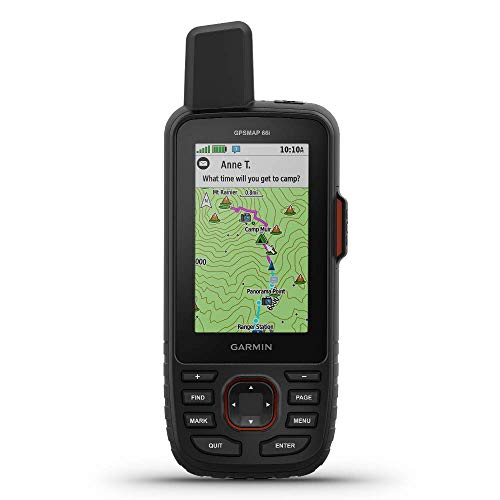
Best for Remote Adventures – Garmin GPSMAP 66i
Among handheld GPS devices for geocaching, the renewed Garmin GPSMAP 66i stands out for pairing navigation with satellite communication. It includes TopoActive mapping, geocaching live access through cellular connectivity, and inReach messaging and SOS capabilities when paired with a required satellite subscription.
Best For: Remote-area geocachers who need two-way satellite messaging and emergency communication alongside navigation.
Pros:
- Large 3-inch sunlight-readable color display.
- Two-way messaging and interactive SOS through the Iridium satellite network with a subscription.
- Preloaded TOPO maps and direct-to-device Birdseye satellite imagery downloads without an annual imagery subscription.
- Battery life reaches up to 35 hours in specified tracking modes or 200 hours in Expedition mode.
Cons:
- Satellite messaging and SOS features require a subscription.
- As a renewed product, it has a listed 90-day limited warranty.
- Its communication features may be more than casual geocachers need.
The GPSMAP 66i is the most feature-rich option here for trips beyond dependable cellular coverage, but ongoing satellite service costs should be included in the buying decision.
Best Budget Navigator – Garmin eTrex 10
The Garmin eTrex 10 is a straightforward option for shoppers seeking handheld GPS devices for geocaching without needing detailed color maps. Its rugged, IPX7-rated design, paperless geocaching support, and simple button controls cover the essentials for basic route and waypoint navigation.
Best For: Budget-conscious geocachers who prefer a simple, durable navigator with long AA-battery runtime.
Pros:
- Supports paperless geocaching and Garmin spine mounting accessories.
- IPX7 waterproofing helps protect against splashes and rain.
- GPS, WAAS, HotFix, and GLONASS support are designed for reliable positioning.
- Runs for up to 20 hours on two AA batteries.
Cons:
- The 2.2-inch monochrome display has limited resolution at 128 x 160.
- It includes a worldwide basemap rather than detailed preloaded trail maps.
- Its 6 MB of storage is modest compared with newer models.
The eTrex 10 makes sense when simplicity and price are more important than color mapping or expanded storage. It is best suited to users comfortable planning around a basic display.
Best Touchscreen Pick – Garmin Oregon 700
For shoppers comparing handheld GPS devices for geocaching, the Garmin Oregon 700 offers a practical touchscreen interface, a dedicated geocache activity profile, and outdoor-ready navigation features. Its 3-inch sunlight-readable display supports landscape or portrait viewing, while the rugged, IPX7 water-rated design is suited to varied conditions.
Best For: Geocachers who want touchscreen control, customizable data fields, and a compact rugged GPS.
Pros:
- 3-inch sunlight-readable capacitive touchscreen with dual orientation
- Geocache activity profile and Connect IQ customization
- 3-axis compass, barometric altimeter, Wi-Fi, Bluetooth, and ANT+ connectivity
- Up to 16 hours of battery life and IPX7 water rating
Cons:
- Battery life is shorter than some newer long-runtime handheld options
- Touchscreen controls may be less convenient when wearing gloves or in wet conditions
The Oregon 700 is a well-rounded choice when an intuitive screen and Garmin’s activity-oriented interface matter more than maximum battery runtime. Its geocaching profile and rugged construction make it especially versatile for regular outdoor use.
Best Battery Life – NiesahYan Rugged Handheld GPS
The NiesahYan handheld GPS is a practical option for those seeking handheld GPS devices for geocaching with long battery life and straightforward button controls. It combines a sunlight-readable 3.2-inch screen with multi-GNSS support, USA Topo maps, and an IP66 water-resistant design.
Best For: Extended hikes and geocaching trips where battery life, physical buttons, and preloaded USA maps are priorities.
Pros:
- Up to 36 hours of rechargeable battery life with USB-C charging
- Supports GPS, Galileo, BeiDou, and QZSS for multi-GNSS positioning
- 3.2-inch sunlight-readable LCD with physical button controls
- Includes USA Topo maps, 32 GB of internal memory, compass, and barometric altimeter
Cons:
- Non-touchscreen interface may feel less intuitive for some users
- IP66 water resistance is specified rather than full submersion protection
This model stands out for endurance and simple physical controls. It is a strong fit for longer outings, particularly for users who want USA Topo maps and broad satellite-system support without depending on a touchscreen.
Best for Preloaded Geocaches – Garmin Montana 680
Garmin Montana 680, Touchscreen Hiking Handheld, GPS/GLONASS with 8 Megapixel Camera
Check Price On AmazonFor geocachers who want content ready to explore, the Garmin Montana 680 includes 250,000 preloaded worldwide geocaches from Geocaching.com. Its touchscreen, GPS/GLONASS receiver, track manager, and geotagging camera make it a feature-rich choice among handheld GPS devices for geocaching.
Best For: Geocachers who value a large preloaded cache database, satellite imagery access, and photo-based trip records.
Pros:
- Includes 250,000 preloaded worldwide geocaches
- GPS and GLONASS support with a high-sensitivity WAAS-enabled receiver
- Track Manager organizes waypoints, routes, and track logs
- 8-megapixel camera automatically geotags photos with coordinates
Cons:
- Up to 16 hours of battery life is modest for extended trips
- The larger 5.7-inch-long body and 0.33 kg weight are less compact than smaller handhelds
- Birdseye Satellite Imagery subscription is listed for one year
The Montana 680 is appealing when built-in geocaching content and trip documentation are more important than a lightweight design. Its track tools and camera add useful capability for recording longer outdoor adventures.
How We Picked the Best Handheld Gps Devices for Geocaching
We focused on the features that matter most during real-world geocaching: satellite accuracy, waypoint handling, screen readability, battery performance, weather resistance, ease of operation, and mapping support. We also considered the differences between basic GPS receivers and premium devices with multi-band positioning, expanded satellite compatibility, wireless connectivity, cameras, or satellite messaging.
Because geocachers have different priorities, this list includes affordable coordinate navigators as well as feature-rich models for hiking, remote travel, and challenging terrain. Product condition also matters, so check whether a listing is new or renewed and review the included accessories, warranty, and battery requirements before buying.
Quick Comparison
- Best for simple, affordable navigation: Garmin eTrex 10 offers straightforward worldwide GPS navigation with a monochrome display.
- Best value for color mapping: The eTrex 22x combines a rugged design with a color screen and preloaded mapping.
- Best for improved positioning: GPSMAP 65 and 65s add expanded satellite support and multi-band technology.
- Best for emergency communication: The GPSMAP 66i combines navigation with inReach satellite messaging and SOS features.
- Best for a large touchscreen: Montana 680 provides a bigger display and an integrated camera, though it is less compact.
Key Buying Factors for Handheld Gps Devices for Geocaching
Accuracy and Satellite Support
Most modern receivers are accurate enough for ordinary cache searches, but multi-band technology and expanded satellite systems can improve performance near trees, cliffs, and buildings. A three-axis compass and barometric altimeter, available on some models, can make orientation and elevation tracking easier.
Screen and Controls
Button-operated units are practical in rain, cold weather, or when wearing gloves. Touchscreens are quicker for browsing maps and entering information but may use more power and be harder to operate in wet conditions. A color display is generally preferable for map detail, while monochrome screens keep cost and battery demands lower.
Battery Life, Durability, and Maps
Look for a waterproof, impact-resistant design and batteries that are easy to replace or recharge in the field. Confirm whether maps are included, downloadable, or sold separately. Wireless syncing can simplify loading waypoints and geocaches, but it may depend on a compatible phone or app.
Connectivity and Emergency Features
Satellite messaging is valuable for remote trips but adds cost and typically requires a subscription. If you mainly geocache in populated areas, prioritize navigation, screen visibility, and battery life instead.
Who Should Buy Which Handheld Gps Devices for Geocaching?
Choose the eTrex 10 if you want the lowest-cost, simplest way to navigate coordinates. Pick the eTrex 22x or 32x for a compact color navigator, with the 32x adding useful orientation hardware. The eTrex SE suits users who want a modern, easy-to-use handheld format.
For difficult environments or frequent backcountry use, the GPSMAP 65 or 65s is the stronger choice, with the 65s adding compass and altimeter functionality. Choose the Oregon 700 or Montana 680 if touchscreen map interaction matters more than minimal size. For remote adventures where communication is as important as navigation, the GPSMAP 66i is the standout option. A generic rugged handheld can be worth considering when price and basic waterproof navigation are the main priorities.