The best stage monitors for music help performers hear vocals, instruments, and backing tracks clearly without relying on the main PA. The right choice depends on venue size, monitoring style, available power, and how much control you need on stage.
This roundup compares 10 options ranging from traditional floor wedges and powered PA speakers to wireless in-ear monitoring systems and nearfield monitors for rehearsal or production.
Best 10 Stage Monitors for Music Picks for 2026
Classic Yamaha Monitoring

- 12-inch woofer with 300W program handling
- Titanium driver and 90° x 40° horn
- Passive wedge with pole socket
Best For: Bands and venues with an external amplifier
Compact Powered Convenience

- 350W bi-amplified powered output
- Two-channel mixer with Bluetooth
- Wedge and pole-mount configurations
Best For: Small gigs, studios, and mobile DJs
Two-Monitor Value Pack
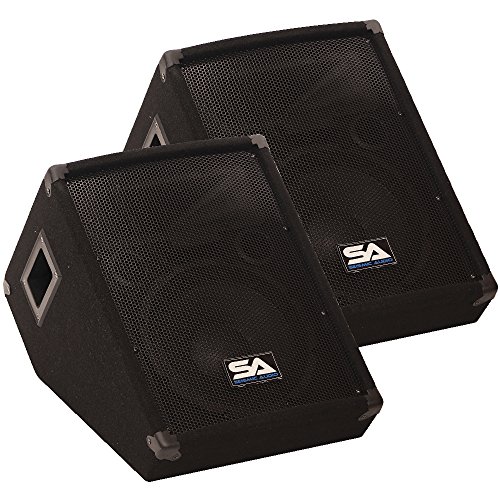
- Pair of passive 10-inch wedge monitors
- 150W RMS and 300W peak per speaker
- Titanium horn with wired XLR/Aux connectivity
Best For: Bands needing two matching passive wedges
Flexible 10-inch Powered Monitor

- 350W bi-amplified powered output
- 10-inch woofer with Bluetooth and mixer
- Wedge or pole-mount operation
Best For: Performers and DJs needing flexible powered monitoring
Best Wireless Pick
JOYO JW-07 Wireless IEM System

- Sub-5ms latency for responsive monitoring
- 40–60 ft open-space range
- Over 8 hours of battery life
Best For: Wireless guitar practice and personal stage monitoring
Best Compact PA Monitor
Behringer B105D 50-Watt Speaker

- 50-watt Class-D powered speaker
- Built-in three-channel mixer
- Bluetooth and USB MP3 playback
Best For: Vocal, keyboard, rehearsal, and multimedia monitoring
Best Studio Pair
PreSonus Eris 3.5 Powered Monitors

- Complete stereo pair with 50 watts
- 3.5-inch woofers and 1-inch tweeters
- TRS, RCA, aux, and headphone connections
Best For: Desktop music production and near-field listening
High-Output Pick
NBVOICE PRX ONE 15-Inch Stage PA System

- 2400W peak output and claimed 131dB SPL
- Bluetooth DSP with presets and feedback suppression
- Tour-ready enclosure with casters and seven-year warranty
Best For: Large venues, touring bands, and outdoor festivals
Compact Desktop Pick
M-AUDIO BX3 3.5-Inch Monitor Pair

- Powered stereo pair with Kevlar woofers
- RCA, 1/4-inch, and 1/8-inch wired inputs
- Front headphone access and rear EQ controls
Best For: Desktop production, streaming, and compact practice setups
Studio Accuracy Pick
JBL 305P MkII 5-Inch Powered Monitor

- Five-inch two-way nearfield studio monitor
- Balanced XLR and 1/4-inch TRS inputs
- Boundary EQ and broad listening sweet spot
Best For: Home studios, mixing, and critical nearfield listening
Classic Yamaha Monitoring – BR12M 12-inch Floor Monitor
The Yamaha BR12M is a traditional passive wedge for musicians who want dependable stage monitors for music with strong output and straightforward amplifier-based setup. Its 12-inch woofer, titanium compression driver, and 90° x 40° horn are designed to provide punchy lows and clear high frequencies for live performances, public address systems, and sound reinforcement.
Best For: Bands, venues, and sound systems that already use an external amplifier or mixer-powered setup.
Pros:
- 12-inch woofer with 300W program and 600W peak power handling
- Titanium compression driver with a 90° x 40° non-resonant horn
- Built-in pole socket allows stand mounting as well as floor use
- Steel handles, corner protectors, and protection circuitry support practical gig use
Cons:
- Passive design requires an external amplifier
- Heavier than the supplied powered 8-inch alternative at 15.6 kg
- No wireless connectivity or water resistance
The BR12M is a solid choice when you prioritize a larger woofer, high sensitivity, and conventional wired integration over built-in amplification or Bluetooth features.
Compact Powered Convenience – Alto TX408 8-inch PA Speaker
The Alto TX408 is a compact powered option for stage monitors for music, small gigs, DJs, and intimate venues. Its 350W bi-amplified design combines an 8-inch woofer, titanium compression driver, built-in two-channel mixer, Bluetooth streaming, and a wedge-monitor configuration in a portable enclosure.
Best For: Small bands, home studios, mobile DJs, and performers who want a lightweight powered monitor with Bluetooth.
Pros:
- 350W Class-D bi-amplified output with 250W LF and 100W HF sections
- Built-in mixer supports microphone, line-level, and Bluetooth inputs
- Bluetooth True Wireless Stereo can provide cable-free stereo linking
- Metal grille, ergonomic handles, and integrated 36mm pole socket improve versatility
Cons:
- 8-inch woofer offers less low-frequency scale than larger monitors
- Only a 75-foot listed Bluetooth range
- Not water resistant
The TX408 is a convenient all-in-one monitor for compact setups, especially when quick setup, low weight, and wireless playback matter more than maximum stage volume.
Two-Monitor Value Pack – Seismic Audio SA-10MT Pair
Seismic Audio - SA-10MT - Pair of 10" Floor / Stage Monitors Wedge Style with Titanium Horn
Check Price On AmazonThe Seismic Audio SA-10MT supplies two wedge-style stage monitors for music, making it a practical option when a band needs matching left-and-right monitoring on a budget. Each passive 10-inch, two-way speaker uses a 150W RMS rating, 300W peak handling, and a titanium compression horn driver.
Best For: Bands and music-event setups that need a pair of wired passive wedges and already have suitable amplification.
Pros:
- Includes two 10-inch floor monitors
- Each speaker is rated at 150W RMS and 300W peak
- 40 oz woofer magnet and 2-inch voice coil support the low-frequency driver
- Titanium compression horn and XLR/Aux connectivity suit wired stage systems
Cons:
- Passive speakers require an external amplifier
- Listed frequency response begins at 160 Hz
- Pair weighs 44 pounds and has no wireless connectivity
This package stands out for covering two performer positions at once, but it is best matched with an amplifier and crossover or mixer setup that can accommodate its passive design and listed response.
Flexible 10-inch Powered Monitor – Alto TX410 10-inch PA Speaker
The Alto TX410 is a versatile powered speaker for stage monitors for music, rehearsals, events, and mid-sized performance spaces. Its 10-inch woofer and 350W bi-amplified system provide more cabinet scale than the TX408, while the wedge-monitor angle, two-channel mixer, Bluetooth, and pole socket support flexible setup.
Best For: Performers, DJs, venues, and presenters who want one powered speaker for floor monitoring, pole mounting, and wireless playback.
Pros:
- 350W bi-amplified output with a 10-inch LF driver
- Built-in two-channel mixer accepts microphone, line, and Bluetooth sources
- Bluetooth streaming and wireless loudspeaker linking add setup flexibility
- Rugged metal grille, handles, wedge positioning, and 36mm pole socket support mobile use
Cons:
- Not water resistant
- Powered design requires AC power at the speaker
- One-year manufacturer warranty is relatively limited
The TX410 is a strong middle-ground choice for users who want the convenience of an integrated powered monitor while retaining the option to use it as a pole-mounted PA speaker.
Best Wireless Pick – JOYO JW-07 Wireless IEM System
For musicians comparing stage monitors for music, the JOYO JW-07 is a compact wireless in-ear option designed for practice, recording, and live performance. Its sub-5ms latency and 2.4GHz transmission are aimed at keeping monitoring responsive.
Best For: Guitar practice, personal monitoring, and performers who want a lightweight wireless setup.
Pros:
- Sub-5ms latency supports near real-time monitoring.
- 48kHz/16-bit audio provides clear monitoring detail.
- Offers 40–60 feet of operating range in open space and over eight hours of battery life.
- Frequency hopping helps reduce interference, with 12 channel banks available.
Cons:
- One transmitter cannot connect to multiple receivers.
- Operating range may vary in crowded or obstructed environments.
The JW-07 makes sense when mobility and personal monitoring matter more than a traditional floor speaker. Its built-in battery and low latency are particularly useful for individual practice and performance monitoring.
Best Compact PA Monitor – Behringer B105D 50-Watt Speaker
The Behringer B105D is a versatile choice among stage monitors for music when you need a small powered speaker rather than in-ear monitoring. Its 50-watt amplifier, three-channel mixer, Bluetooth, and USB MP3 playback suit vocal, keyboard, and multimedia duties.
Best For: Vocalists, keyboard players, home recording setups, presentations, and compact live-performance rigs.
Pros:
- 50-watt Class-D amplification in a lightweight, compact enclosure.
- Three-channel mixer includes a three-band EQ.
- Bluetooth supports wireless audio streaming from compatible devices.
- USB MP3 playback allows audio files to be played from a flash drive.
Cons:
- Its 5-inch woofer is less suited to deep bass than a larger PA system.
- The speaker is corded electric and not water resistant.
The B105D is a practical all-in-one monitor for smaller spaces and mixed-use setups. Choose it when you want onboard mixing and playback features in a tabletop-friendly speaker, rather than a dedicated studio pair.
Best Studio Pair – PreSonus Eris 3.5 Powered Monitors
The PreSonus Eris 3.5 pair is a strong desktop-oriented option for shoppers considering stage monitors for music alongside studio and home audio work. These active near-field monitors provide 50 watts of built-in amplification, multiple wired inputs, and acoustic tuning controls.
Best For: Home music production, desktop listening, gaming, streaming, and near-field monitoring.
Pros:
- Sold as a complete stereo pair with 50 watts of built-in amplification.
- 3.5-inch woven-composite woofers and 1-inch silk-dome tweeters deliver balanced sound.
- High- and low-frequency controls help tailor the response to the room.
- Includes balanced TRS, RCA, front aux, and headphone connections.
Cons:
- Designed for desktop or near-field use rather than projecting across a large stage.
- Requires corded power and is not water resistant.
The Eris 3.5 is best viewed as a compact studio-monitor pair, not a conventional live PA wedge. Its stereo format, tuning controls, and broad input selection make it especially useful for producers and musicians building a small home setup.
High-Output Pick – NBVOICE PRX ONE 15-Inch Stage PA System
For musicians who need stage monitors for music in larger venues, the NBVOICE PRX ONE emphasizes high output, wide coverage, and touring durability. Its 15-inch subwoofer, 2400W peak power, and claimed 131dB SPL suit demanding live events, while Bluetooth DSP control adds practical setup flexibility.
Best For: Touring bands, outdoor festivals, worship spaces, and large live events.
Pros:
- High-output system with a 15-inch subwoofer and claimed 131dB SPL.
- Bluetooth DSP control includes presets and feedback-suppression features.
- Road-ready birch enclosure, industrial casters, and a seven-year warranty support touring use.
- Broad connectivity includes XLR/TRS, RCA, AUX, USB, and Bluetooth 5.3.
Cons:
- At about 128–130 pounds, it is substantially heavier than compact monitor speakers.
- Its large cabinet and high output may be excessive for small rooms or desktop monitoring.
The NBVOICE is the most event-focused option here. Choose it when coverage, physical durability, and integrated control matter more than portability or nearfield studio accuracy.
Compact Desktop Pick – M-AUDIO BX3 3.5-Inch Monitor Pair
The M-AUDIO BX3 is a compact alternative for musicians seeking stage monitors for music practice, streaming, or small desktop setups. This powered stereo pair combines 3.5-inch Kevlar woofers, silk-dome tweeters, wired inputs, and front-panel headphone access in a space-conscious design.
Best For: Desktop music production, rehearsal playback, podcasting, gaming, and live-streaming setups.
Pros:
- Compact powered stereo pair with 3.5-inch woofers and silk-dome tweeters.
- Multiple wired inputs include RCA, 1/4-inch, and 1/8-inch connections.
- Front headphone access supports quiet monitoring and late-night work.
- Rear EQ controls and speaker-position switching allow basic sound adjustment.
Cons:
- Small drivers are better suited to desktop use than large-stage coverage.
- The speakers are wired and not water resistant.
The BX3 is a practical, affordable-size monitoring solution when space and connectivity are priorities. It is not a substitute for a high-output PA system, but it fits compact music and multimedia work well.
Studio Accuracy Pick – JBL 305P MkII 5-Inch Powered Monitor
The JBL 305P MkII is a single powered nearfield monitor designed for music production rather than full-stage reinforcement. Its five-inch woofer, balanced inputs, boundary EQ, and broad listening sweet spot make it a strong choice for focused mixing and desktop studio work.
Best For: Home studios, nearfield music production, mixing, and critical desktop listening.
Pros:
- Five-inch two-way design with updated transducers for detailed highs and deep bass.
- Balanced XLR and 1/4-inch TRS inputs support studio equipment.
- Boundary EQ helps compensate for placement on a desk or near a wall.
- Broad sweet spot and 82W of integrated Class-D amplification support off-axis listening.
Cons:
- Sold individually, so a stereo setup requires two speakers.
- It is a corded, non-wireless monitor without stage-PA output capability.
- Not water resistant.
The 305P MkII is the best fit when accurate nearfield monitoring is the priority. For stage monitors for music in a live venue, select a PA-oriented system instead; for mixing and production, this JBL offers more appropriate features.
How We Picked the Best Stage Monitors for Music
We selected these monitors based on the features that matter most during rehearsals, performances, and music production: sound coverage, output capability, portability, connectivity, monitoring format, and overall suitability for different users. The list includes powered and passive-style options, floor wedges, compact PA speakers, wireless in-ear monitoring, and studio monitors.
Because no single monitor works for every setup, we considered practical use cases rather than ranking products on power alone. A compact speaker may be ideal for vocals or personal practice, while a larger powered cabinet is better suited to a full band or louder stage.
Quick Comparison
- Traditional floor wedges: Yamaha BR12M and Seismic Audio SA-10MT options suit performers who want familiar stage-facing monitor placement.
- Powered PA monitors: Alto TX408 and TX410 provide simpler setups because amplification is built in.
- Wireless monitoring: The JOYO wireless IEM system is designed for performers who prefer in-ear monitoring and reduced stage clutter.
- Compact personal monitors: Behringer’s B105D is useful for speech, vocals, small performances, and practice spaces.
- Large-format PA: The NBVOICE PRX ONE targets users who need substantially more output and broader event coverage.
- Studio-focused choices: PreSonus Eris 3.5, M-AUDIO BX3, and JBL 305P MkII are better suited to nearfield listening, music production, and desktop monitoring than loud live stages.
Key Buying Factors for Stage Monitors for Music
Powered or Passive Design
Powered monitors include an amplifier, which reduces the amount of external equipment and simplifies setup. Passive wedges can be flexible in larger systems, but they require a compatible power amplifier and appropriate speaker cables.
Output and Headroom
Choose enough output for the venue, ensemble, and stage volume. More headroom can reduce distortion when performers need loud vocals or instruments, but excessive power is unnecessary for quiet rehearsal rooms or desktop use.
Speaker Size and Coverage
Eight- and 10-inch speakers are often easier to transport and can work well for vocals or small groups. Twelve- and 15-inch designs generally provide fuller low-frequency response and higher output, although they are heavier and take up more space.
Inputs, Mixing, and Wireless Features
Check whether the monitor accepts the connections your mixer or source provides. XLR and quarter-inch inputs are common for live systems, while Bluetooth, USB, DSP controls, or wireless transmission may be useful for specific rehearsal and performance workflows.
Placement and Feedback Control
Wedge monitors should be positioned toward the performer while keeping microphones outside the speaker’s most sensitive pickup path. Equalization, sensible volume levels, and careful placement are essential for reducing feedback.
Who Should Buy Which Stage Monitors for Music?
Choose a powered wedge if you want straightforward live monitoring with minimal additional equipment. Choose a passive wedge if you already own an amplifier or operate a scalable PA system. Choose wireless IEMs when mobility, lower stage volume, and a cleaner stage are priorities.
Choose a compact PA monitor for presentations, vocals, small venues, or practice. Choose a larger PA speaker for bands, events, and spaces that require greater output. If your main goal is mixing, recording, or desktop listening, select a nearfield studio monitor instead of a live floor wedge.